
Orange County Sex Offender Records
Sex offenders in Orange County register through the Sheriff's SONAR unit, which stands for Sex Offender Notification and Registration. The sheriff coordinates registration for unincorporated areas while cities with police departments handle their own registrations. Anyone convicted under California Penal Code Section 290 must register with the appropriate agency based on where they live. You can search for registered offenders using the California Megan's Law website by entering an Orange County address. Offenders register within five working days of moving to the county or being released from custody. Annual updates occur on each person's birthday, with more frequent check-ins for transients and sexually violent predators.
Orange County Quick Facts
SONAR Unit Registration
The Orange County Sheriff's SONAR unit manages sex offender notification and registration for unincorporated areas. Call 714-647-7419 to contact SONAR. If you live in a city with its own police department, register with that agency instead. Many Orange County cities including Anaheim, Santa Ana, Irvine, and Fullerton have their own police departments with registration units.
When registering, bring valid photo ID and proof of your current address. This can be a utility bill, lease, or mail with your name and Orange County address. If you own a vehicle, bring registration documents. Staff will photograph you and collect fingerprints. You provide details about where you live, where you work, and any vehicles you own. You must also disclose internet identifiers like email addresses and social media usernames.
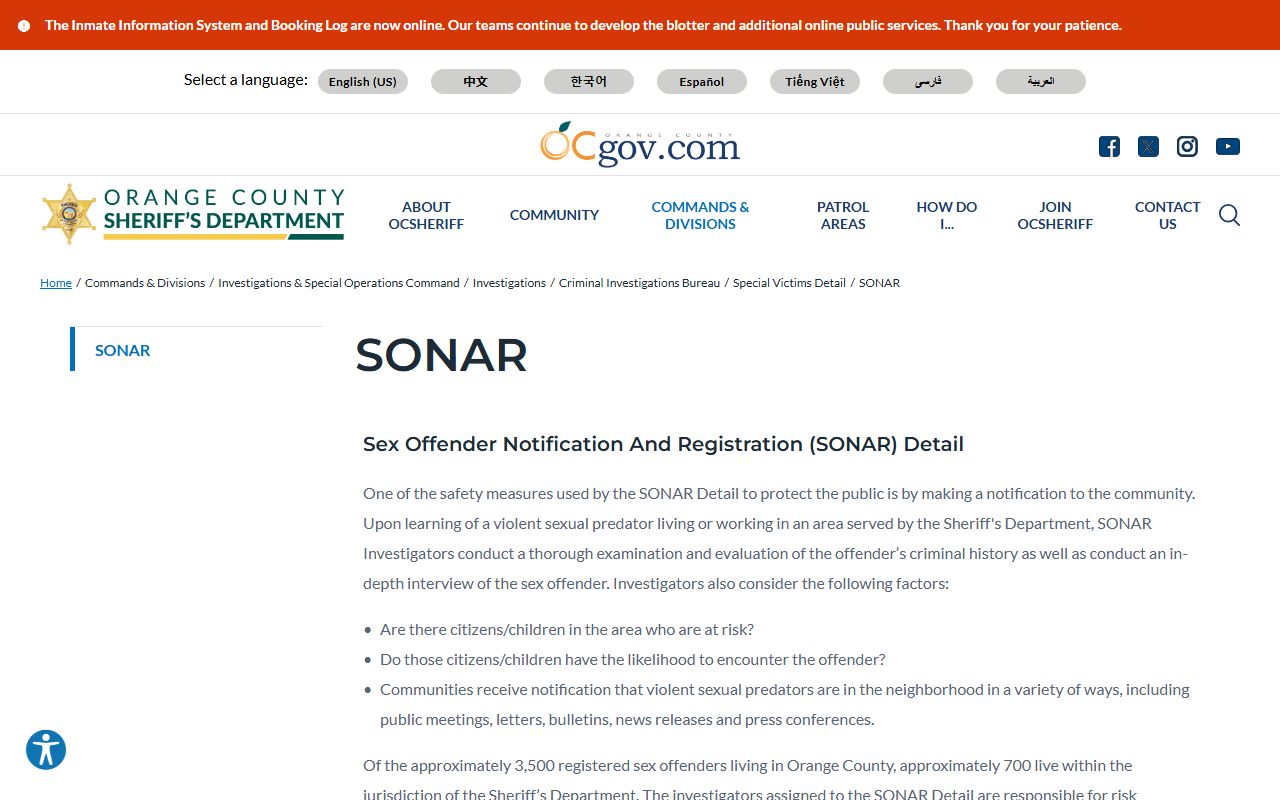
The process takes about 30 minutes. The local agency then submits your data to the California Department of Justice. Visit ocsheriff.gov/commands-divisions/investigations-special-operations-command/investigations/criminal-0 for more about the SONAR detail. The sheriff and local police departments maintain files on all registered offenders. Deputies and officers conduct compliance checks regularly to verify addresses and employment.
Megan's Law Database
California's Megan's Law website at meganslaw.ca.gov is the main tool for searching sex offenders. Enter an Orange County address to see a map of registered individuals nearby. The map uses pins to mark each offender's location. Click on a pin to view the profile. Most profiles include a photo, physical description, and conviction details.
Each profile displays the tier level. Tier One offenders register for ten years. Tier Two offenders register for twenty years. Tier Three offenders register for life. Some profiles show full street addresses. Others only display a zip code or mark the person as undisclosed per court order. The amount of detail depends on the offender's tier and legal restrictions.
The website updates daily based on reports from local agencies across Orange County. If someone just registered, the profile might not appear until the next day. Not all registered offenders are on the public site. Some are excluded by law. Certain juvenile offenders and misdemeanor cases do not get posted. If you cannot find someone, call the sheriff or local police to ask about that individual.
Registration Requirements
Initial registration must occur within five working days. This applies when you are released from jail or prison, when you move to Orange County, or when you first become subject to registration. Five working days means business days only. Weekends and holidays do not count. If released on a Friday, you have until the following Friday to register.
Annual updates happen on your birthday. The law requires updating within five working days before or after that date. If your birthday is December 28, you can register anytime from December 23 to January 2. The local agency does not send reminders. You must track the date and appear on time. Missing the window is a violation that can lead to criminal charges.
Transients update every 30 days. You are classified as transient if you lack a permanent residence. This includes living in a vehicle, staying in a shelter, or moving between temporary locations. The local agency makes the final determination. If deemed transient, you must update every 30 days and report where you have been staying.
Sexually violent predators update every 90 days regardless of housing status. This category includes individuals civilly committed as SVPs or those with certain convictions. The 90-day schedule is more frequent than the annual birthday update but less burdensome than the 30-day transient requirement. All timelines are set by Penal Code Section 290.012.
Tier System
California's tier system took effect in January 2021 under Senate Bill 384. It replaced lifetime registration for many offenders. Now duration depends on the tier. Tier One is ten years for adults and five years for juveniles. Tier Two is twenty years for adults and ten years for juveniles. Tier Three is lifetime with no early termination.
The tier is assigned at conviction based on the specific crime. Rape under Penal Code Section 261 is typically Tier Three. Lewd acts with a child under Penal Code Section 288 can be Tier Two or Tier Three. Indecent exposure might be Tier One. The statute sets the tier. Judges do not have discretion to change it.
After completing the minimum period, Tier One and Tier Two offenders can petition the court for removal from the registry. The petition goes to the court that handled your conviction. You may need legal help to prepare the paperwork. The court has 60 days to decide. If approved, you stop registering and your profile is removed from the public website. Tier Three offenders cannot petition unless they obtain a pardon.
Additional Resources
The California Department of Justice oversees the statewide sex offender registry. Visit oag.ca.gov/sex-offender-reg for forms, FAQs, and policy updates. You can download an Application for Exclusion from Internet Disclosure if you qualify. The DOJ also publishes statistics on total registrants. Processing exclusion applications takes 30 to 90 days or longer.
For inmates in state custody, use the California Incarcerated Records and Information Search at ciris.mt.cdcr.ca.gov. Search by name or CDCR number to find current location, admission date, and parole hearing dates. This helps you know when someone will be released and required to register in Orange County or elsewhere.
The National Sex Offender Public Website at nsopw.gov searches all state registries. Use it to check if someone has a registration history in another state before moving to California. The federal site is free and does not require a login. The U.S. Department of Justice runs the site.
Legal aid organizations in Orange County can assist with registration questions or petitions. Legal Aid Society of Orange County and Public Law Center serve the area. Call their intake lines to see if you qualify for free help. Private attorneys also handle sex offender registry cases. Expect to pay for a consultation and legal work if you hire a lawyer.
Cities in Orange County
Orange County includes several cities with populations over 100,000:
Anaheim | Santa Ana | Irvine | Huntington Beach | Garden Grove | Orange | Fullerton | Costa Mesa
Each city with a police department handles its own registrations.
Nearby Counties
For sex offender information in surrounding counties, see:
Los Angeles County | San Bernardino County | Riverside County | San Diego County